
By Casey Neill
Finding out you’re losing your vision would be a pretty significant setback for most teens.
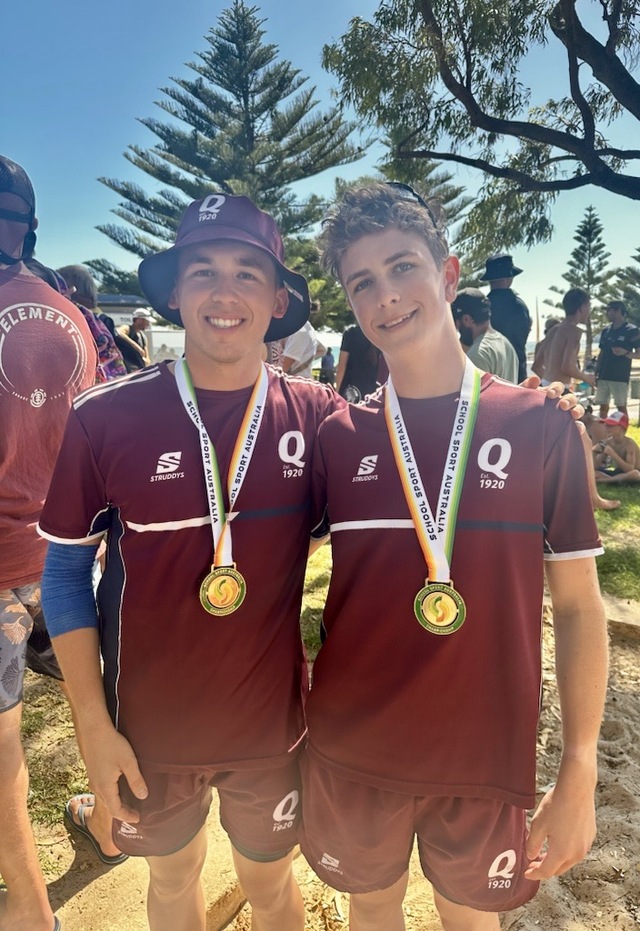
But Mitchell Wilkes says his Stargardt disease diagnosis fast-tracked his path to becoming an elite athlete.
Four years on, the 16-year-old has a 2032 Paralympics triathlon gold medal firmly in his sights.
“I didn’t really view my diagnosis as a setback or a disability,” Mitch said.
“It didn’t occur to me that it should be something to hold me back.”
Stargardt’s is a genetic condition that affects central vision.
“I have a tennis ball-sized black spot that will get worse,” Mitch explained.
“Throughout the later months of Year 7, Mum noticed I wasn’t reading stuff I should have been able to.”
So Mitchell saw an optometrist, who sent him to an ophthalmologist, who identified the devastating cause.
“I don’t think I gave it as much thought as I probably should have,” he said.
“I didn’t really realise the implications for the future.
“The only things I can think of are positive: I’ve gotten into triathlon and started a big sporting career. I’ve got more into the music side of things, doing saxophone and piano.”
His parents’ reaction was “a lot more emotional than mine”.
“If you got told that your son was going to be blind by 30, it would be a bit of a knock on the head,” he said.
“I haven’t tried to think about it like that very often.
“I try to think about the here and now and what I can control.
“My vision is at a point where I’m still very independent and I can navigate pretty well on my own.
“My laptop mirrors the board in the classroom, so I can see what the teacher is writing.
“I also have extra time in exams and everything’s given to me digitally.”
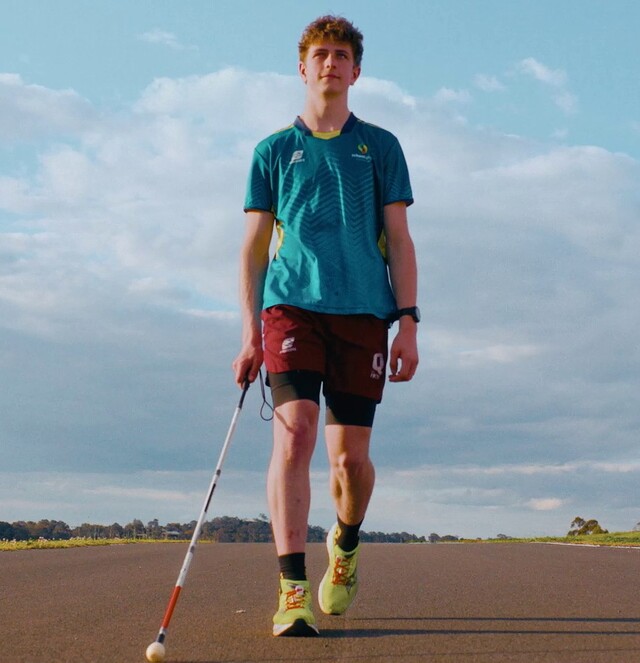
A white cane is crucial for Mitch’s independence. He spoke to us for International White Cane Day as an ambassador for Guide Dogs Australia.
“I use a white cane when travelling in unfamiliar environments,” he said.
“One of the big things that it is helpful for is awareness.
“It’s a very recognisable symbol of low vision for a lot of people.
“My disability is very invisible. You don’t look at me and go ‘he’s blind’.
“It brings to the surface what I’m dealing with on a day-to-day basis.
“When I’ve been travelling without it in airports before I got it, I would skim pretty close to people and that sort of thing.
“When I got the cane, people did give me that extra bit of room, and priority with going through security and things.”
Guide Dogs said a polite introduction and offer of assistance was always appreciated, but don’t be offended if your help is declined.
“Just because I have a white cane and I’m navigating differently to you, it doesn’t necessarily mean I need assistance at all times,” Mitch said.
“Being able to be independent is important. The cane allows me to do that.”
Never touch a white cane or its user unless invited. Keep pathways clear, give white cane users extra walking space, and look up from your phone to avoid collisions.
“If someone does come up to you and is asking for help, be very willing to help them,” Mitch said.
“Something that I know a lot of low vision people struggle with is actually asking for help.
“So when they do, it’s probably something that they are really struggling with.”
At the time of his diagnosis, Mitch noted three things he wanted to achieve while his vision still allowed: skydiving, walking to Everest Base Camp, and walking the 250-kilometre Larapinta Trail in the Northern Territory.
“Since I was really young, I have always wanted to skydive,” he said.
“I didn’t want to skydive blind, then you wouldn’t see the crazy landscape you were falling into.
“I‘ve always wanted to summit Everest, but Mum said that was way too dangerous. It’s also very expensive.
“We had done two sections of the Larapinta Trail when I was about 8. I can’t leave anything unfinished, so I had to go back.
“The only new goal that’s come on the radar is getting gold at the Paralympics.
“I’m training for three sports at once, so I usually get nine sessions in each week – two swims and four runs and three to four bikes.
“A while back, before I got the diagnosis, one of my teachers from junior school suggested I get into triathlon. I kind of put it in the back of my mind.
“After my diagnosis, I started with aquathlon, because I couldn’t find a tandem bike – they’re very hard to come by – then I transitioned to triathlons.
“We’re aiming for ultimately 2032 in Brisbane, but along the way we’re going to also aim for LA and the World Triathlon Championship Series.”