
By Casey Neill
Suzanne Lee witnesses the power of equine-assisted therapy first-hand.
“One moment that has stayed with me involved a child who never spoke and avoided eye contact,” the Cardinia Equine Assisted Counselling founder and principal practitioner said.
“For weeks, they sat quietly in the paddock while Tobi, one of our small therapy pony team, grazed nearby.
“One day, Tobi walked over and stood beside this child, close enough that their shoulders touched.
“The child leaned gently into the pony and softly said, ‘You stayed.’ It was the first time they had spoken in therapy.
“Tobi became an anchor for this child to start feeling safe to communicate and express their needs.”
Suzanne said equine-assisted therapy looked very different from what many people imagined therapy to be.
“It is not horse riding, and it is not a recreational activity. People don’t come to learn to ride or to be instructed in horsemanship,” she said.
“Instead, equine-assisted therapy is a structured, therapeutic intervention that must be delivered by a qualified allied health professional or trained therapist, with appropriate clinical training and oversight.
“Sessions focus on relationship, emotional safety, and supporting a person’s capacity to grow
and develop in ways that feel safe and meaningful for them.
“The horses are not the therapist.
“Rather, they are carefully supported co-regulation partners who contribute to the therapeutic process under the guidance of the therapist.”
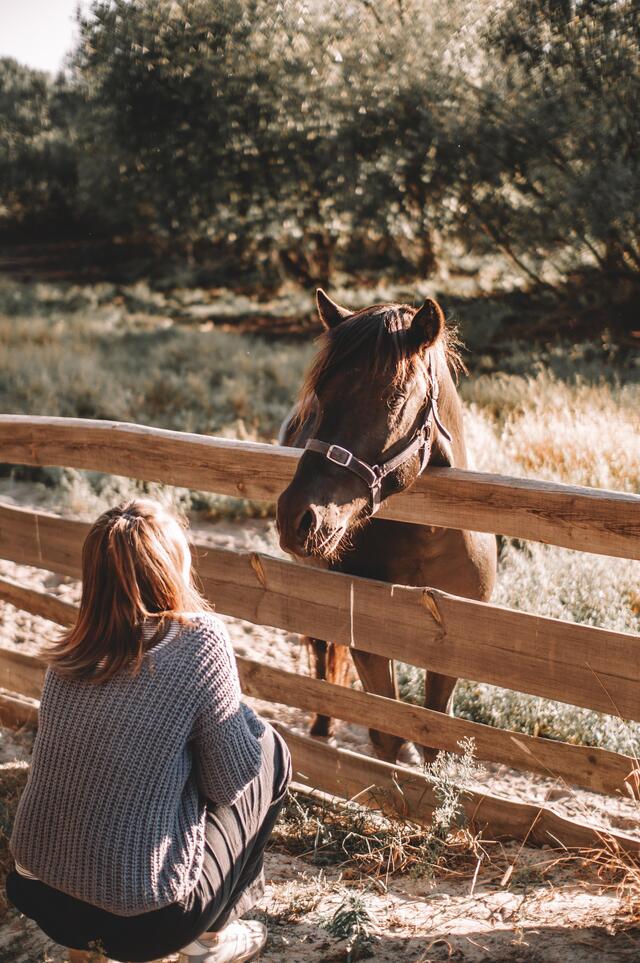
Sessions usually take place in paddocks or quiet farm spaces.
“Children, adolescents, and adults might brush a horse, walk alongside them, sit nearby and observe, or simply share space,” Suzanne said.
“Individuals are supported to make choices, listen to their bodies, and engage at their own pace.
“Horses respond naturally to how a person is feeling, often before there are words for those feelings.”
Many children who come to Suzanne have tried talk-based therapy and found it overwhelming or inaccessible.
“Some people don’t yet have the language to explain what they are feeling, while others struggle in structured, indoor environments,” she said.
“Equine and animal-assisted therapy allows people to build capacity through experience.”
Suzanne also works with a range of therapy animals, including dogs, cats, and birds.
“Horses, however, offer something unique within a therapeutic context,” she said.
“From a neuroscience perspective, horses are highly attuned to non-verbal communication.
“As prey animals, their nervous systems are designed to notice subtle changes in body language, breathing, muscle tension, and emotional state.
“Humans – particularly those who have experienced stress or trauma – often communicate in these same non-verbal ways.
“When supported by a trained therapist, a horse’s responses can help individuals become
aware of their own internal states.
“Over time, many people notice that when they slow their breathing or soften their posture, the horse relaxes too.
“This supports emotional regulation, self-awareness, and agency – not because it is taught or instructed, but because it is experienced.”
Suzanne often sees people who initially are afraid of horses find strength in moving through that fear.
“Some people begin by observing from a distance, then slowly step closer, and perhaps one day reach out to touch a horse’s mane,” she said.
“These small moments carry a lot of meaning.
“With therapeutic support, individuals learn they can approach something that feels big or uncertain and remain safe.
“This experience often strengthens confidence, trust in self, and the capacity to face
challenges in other areas of life, including relationships, learning, and everyday situations.”
Suzanne came to equine-assisted therapy through her professional training and her lived
experience of how powerful animals and nature can be in supporting emotional wellbeing
and development.
“I am a registered counsellor and allied health professional, and I have spent many years working with children, adolescents, and adults who have experienced trauma, anxiety, neurodivergence, disability, or emotional overwhelm,” she said.
“Equine-assisted therapy requires specialist training that integrates counselling skills, trauma-
informed practice, nervous system regulation, and an understanding of both human and
animal welfare.
“My role is to hold the therapeutic framework, ensure emotional and physical safety, and support each person’s goals, while the horses support the process through their sensitivity and presence.”